
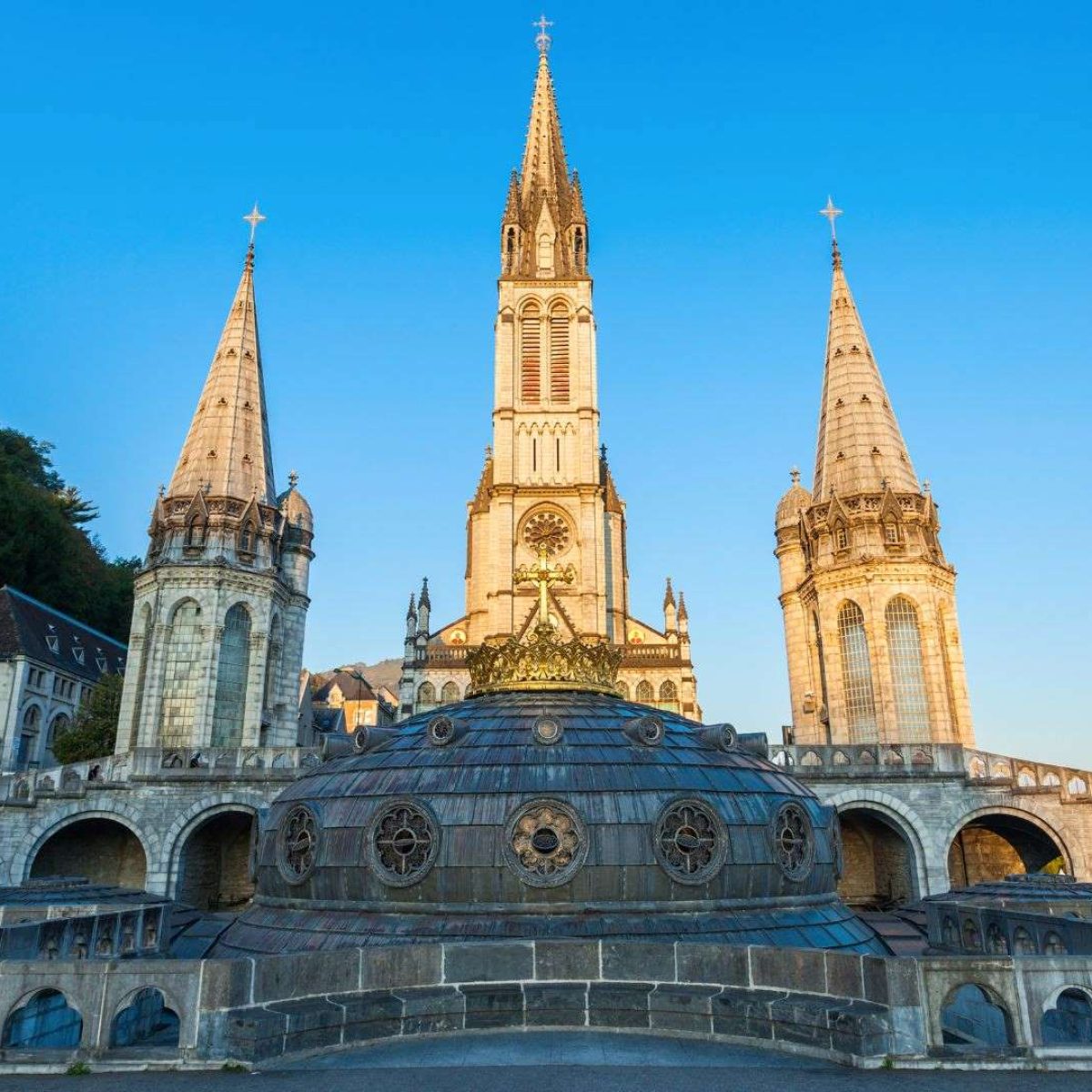
Nestled at the foothills of the Pyrenees in southwestern France, Lourdes holds a unique place in Christian history. Known worldwide as a major Christian pilgrimage site, Lourdes welcomes millions of pilgrims every year seeking healing, comfort, spiritual renewal, or a deeper understanding of their faith.
More than a destination, Lourdes represents a profound encounter between history, spirituality, and human vulnerability. Its global influence, rooted in a specific historical moment, continues to shape Christian pilgrimage today.
Lourdes is located in the Hautes-Pyrénées region of southern France, close to the Spanish border. Surrounded by mountains and crossed by the Gave de Pau river, the city offers a natural environment that naturally invites silence, reflection, and contemplation.
This geographical setting plays a meaningful role in the pilgrimage experience. The surrounding landscape creates a sense of retreat, helping pilgrims step away from daily distractions and enter a space conducive to prayer and spiritual focus.
The story of Lourdes changed forever in 1858, when a young girl named Bernadette Soubirous reported a series of apparitions of the Virgin Mary in a small grotto outside the town.
Between February and July 1858, 18 apparitions were recorded. During one of these encounters, the Virgin identified herself as “the Immaculate Conception,” a theological declaration that deeply resonated within the Catholic Church.
These events marked the beginning of Lourdes as a Christian pilgrimage destination, later officially recognized by the Church. Bernadette Soubirous remains a central figure in understanding the spiritual significance of Lourdes.
At the center of the Lourdes Christian pilgrimage lies the Sanctuary of Our Lady of Lourdes, a vast spiritual complex built around the Grotto of Massabielle, where the apparitions took place.
The sanctuary includes several basilicas, prayer areas, and open spaces designed to welcome pilgrims from around the world. Each year, visitors participate in:
Official and updated information can be found on the website of the Sanctuary of Our Lady of Lourdes, an authoritative external reference for pilgrims and visitors.
One of the most widely known aspects of Lourdes is its association with reported healings. Over the years, thousands of pilgrims have claimed physical or spiritual healing after visiting Lourdes.
These cases are examined through a rigorous process led by the Lourdes Medical Bureau, which applies strict medical and scientific criteria. Only a very limited number of healings are officially recognized as miracles, reinforcing the credibility and seriousness of the sanctuary’s approach.
Today, Lourdes is one of the most visited religious tourism destinations in the world. Pilgrims arrive individually, with parishes, dioceses, or organized Christian groups from Europe, North America, Latin America, and Asia.
Despite the scale of visitation, Lourdes has maintained a strong spiritual identity. Hospitality, care for the sick, and attention to vulnerable visitors remain central to the city’s mission and values.
While Lourdes is deeply rooted in Catholic tradition, it is not reserved solely for practicing Catholics. Many visitors come as seekers, drawn by the spiritual atmosphere, the message of hope, or a personal need for reflection.
For many, a pilgrimage to Lourdes becomes a moment of inner questioning, reconciliation, or renewal. This universal dimension explains why Lourdes continues to resonate across cultures, generations, and faith journeys.
Lourdes is often included in broader Christian pilgrimage routes in France, alongside other significant sites of Christian heritage. It frequently serves as a key stage in longer spiritual journeys designed for international pilgrims.
From an editorial and educational perspective, Lourdes naturally connects with content related to Christian heritage in France and faith-based travel, offering valuable internal linking opportunities.
Lourdes is far more than a historical site. It is a living place of faith, where spirituality, compassion, and human experience intersect. Its international reach, spiritual depth, and historical significance make it one of the most important Christian pilgrimage destinations in the modern world.
To understand Lourdes is to understand a central expression of contemporary Christian pilgrimage — one rooted in humility, hope, and encounter.
Our Solutions for Your Journey
Activities Included in Our Trips
Lourdes became a Christian pilgrimage site after the Marian apparitions reported by Bernadette Soubirous in 1858, later recognized by the Catholic Church.
Lourdes is located in southwestern France, in the Hautes-Pyrénées region, at the foothills of the Pyrenees mountains.
The Grotto of Massabielle is the site where Bernadette Soubirous reported seeing the Virgin Mary and is the spiritual heart of the Lourdes sanctuary.
While Lourdes is a major Catholic pilgrimage site, many non-Catholics and non-practicing visitors come for spiritual reflection, history, or personal reasons.
Lourdes welcomes several million pilgrims and visitors each year, making it one of the most visited religious pilgrimage sites worldwide.